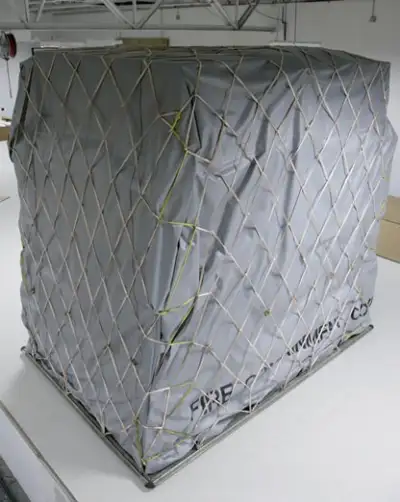
1. Warehouses and Logistics
In logistics and storage facilities, fire containment covers serve as a vital protective barrier for high-risk cargo. They help prevent fires from spreading between pallets of lithium-ion batteries, flammable goods, and other hazardous materials, while also enabling warehouse staff to handle and store items safely.
These covers act as a first line of defense during accidental sparks or fires, allowing operators to quickly isolate the affected area. In major cargo warehouses, lightweight and reusable fire containment covers make it possible to contain a fire without disrupting nearby inventory, ensuring both safety and operational continuity.
2. Ships and Offshore Platforms
Marine and offshore environments present some of the most challenging fire protection scenarios. In these confined and high-risk areas, the combination of flammable fuels, pressurized systems, and limited evacuation routes makes fire containment a critical safety requirement.
Fire Containment Covers are used to protect vital onboard systems such as engine compartments, critical machinery, and storage spaces. These covers are:
Built to endure extreme marine conditions - including high humidity, salt exposure, vibration, and mechanical abrasion.
Designed for quick deployment during emergencies or maintenance to immediately isolate fire sources and prevent flame spread, or installed as permanent curtains to segment or isolate dangerous areas.
Cover hazardous waste, chemicals, oils, or dirty rags and flammable waste
Tested for high thermal resistance and flame penetration to ensure reliable containment even under prolonged exposure to heat and flame.
By localizing fires and preventing them from reaching adjacent systems, these covers help stop small incidents from escalating into catastrophic fires at sea, protecting both crew safety and vessel integrity.
3. Aerospace and Aviation
In the aerospace industry, transporting hazardous cargo such as lithium-ion batteries, flammable chemicals, or sensitive materials carries a significant fire risk. Even a small ignition can escalate quickly, potentially affecting an entire pallet of cargo and putting both aircraft and crew at risk. This creates a clear need for effective fire containment solutions that can control fire before it spreads and provide crucial response time.
FireCape® Fire Containment Covers address this challenge by containing palletized cargo fires for up to six hours. This extended protection gives flight crews and ground personnel enough time to implement emergency procedures safely.
These covers are designed to withstand intense fires from lithium-ion batteries and other hazardous goods, act as a reliable barrier, preventing flames from spreading to nearby cargo or aircraft systems.
Check out our collection of high-temperature textiles here!
Testing & Certifications of Our Fire Containment Covers
Our FireCape Fire Containment Covers are engineered with Z-Block fire-resistant materials for extreme conditions and undergo rigorous testing to ensure reliability, durability, and safety in high-risk industrial applications. These certifications demonstrate that our products meet stringent international standards and perform effectively in real-world fire scenarios.
FireCape® Fire Containment Covers Certifications
FAA TSO-C203 Approval: Confirms compliance with aviation standards for containing palletized cargo fires.
ISO 14186 / SAE AS 6453 – Full Scale Box Burn: Validates performance under realistic, high-heat fire conditions.
Z-Block™ Material Testing
ISO 12236 – Static Puncture Test: Ensures resistance to punctures, making the covers durable for heavy or irregular loads.
FAR 25 Appendix F (Part III & Part V – Flame Penetration & Smoke Density): Confirms minimal flame penetration and controlled smoke levels for aviation safety.
ASTM D6413 – Vertical Flame Resistance: Tests a fabric’s ability to resist vertical flames.
ASTM E-84 – Surface Flame Spread & Smoke Density: Evaluates how quickly flames and smoke can spread across the fabric surface.
ASTM F-955 – Molten Metal Resistance: Verifies the fabric withstands splashes of molten metal without degradation.
ASTM E-119 – Furnace Tested: Assesses thermal resistance under extreme furnace temperatures.
UL 1784 – Smoke Penetration: Ensures smoke does not easily pass through the fabric.
BSS 7239 – Non-Toxicity of Products of Combustion: Confirms that materials do not emit harmful gases if exposed to fire.
These certifications and tests assure that our fire containment covers are high-performance, safe, and compliant.
More Helpful Articles:
From Fabrics to Finished Solutions: Designing Effective Fire Containment Systems for Industrial Settings
Sustainable Sourcing at High Temperatures: How ‘Made in USA’ High-Temp Textiles Support Local Industry
Best Heat-Resistant Fabrics for Industrial Applications
Conclusion
Fire containment covers have become a cornerstone of modern industrial safety - offering a reliable line of defense where fire risks are unavoidable. From aviation and marine sectors to logistics, manufacturing, and energy operations, these covers play a crucial role in limiting fire spread, minimizing damage, and protecting both personnel and equipment in high-temperature environments.
As industries continue to evolve with higher energy densities, complex materials, and stricter safety standards, the importance of these covers will only increase - shaping the future of fire protection and containment technology across the globe.